


1win Prediction Market - Betting on political, cultural and media events

Maximum bonus of INR 47,600!
Overview of the 1win prediction market in India
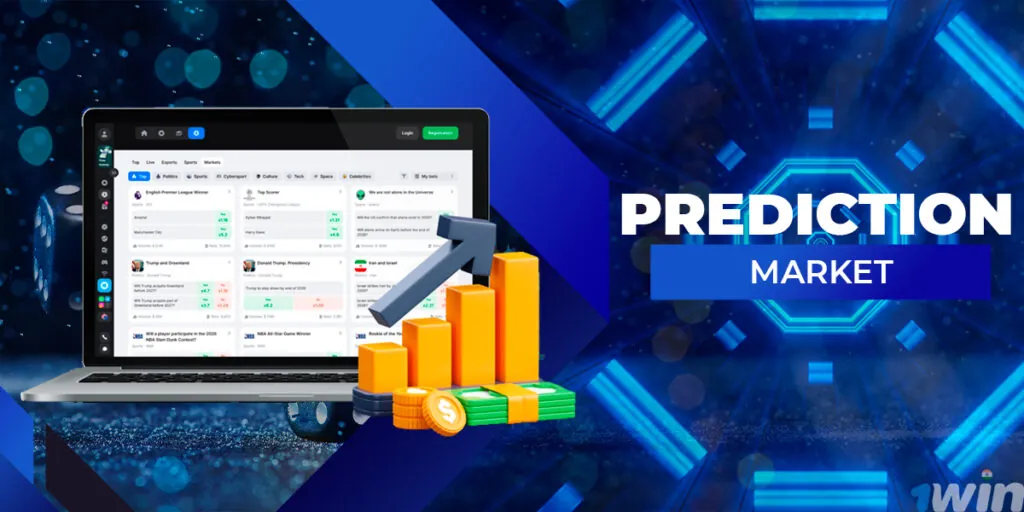
A prediction market is a type of online forecasting space where users react to future events by choosing the outcome they think is most likely. The topics can be wide-ranging, for example:
- sports results.
- political elections or policy decisions.
- consumer and tech trends.
- economic indicators (such as price moves).
- entertainment outcomes (awards, box office, etc.).
At its core, a prediction market works like a crowd-sourced “probability board.” As more people pick an outcome, the displayed likelihood can move in response to that crowd signal.
1win is known for online gaming services, and some of its pages or interfaces may present prediction-style markets on upcoming events. In India, interest in these formats often ties back to sports culture (especially cricket), plus the general habit of following big news cycles online.
How a 1win-style prediction market works
Most prediction markets follow a similar structure:
- Event listing: An event appears with two or more possible outcomes.
- User forecasts: People select the outcome they think will happen.
- Aggregation: The platform summarizes everyone’s inputs into a probability/odds-style display.
- Resolution: Once the real-world result is known, the market is closed and settled as “correct” or “not.”
A few terms you’ll see a lot:
- Probability: A number that represents how likely an outcome is.
- Odds: Another way to express likelihood, often used on betting-style interfaces.
- Market movement: If a large share of users choose one outcome, the displayed probability can shift.
- Liquidity/volume: Bigger, busier markets usually look steadier; tiny markets swing more easily.
This section is about the mechanics and vocabulary, not instructions for placing bets.
Legal status of prediction markets in India
In India, the legal picture around online prediction markets—especially those that involve money—is not simple.
Central vs state rules:
- The Public Gambling Act (1867) is often referenced, but it was written long before modern digital platforms.
- Many states have their own gambling laws, and some explicitly regulate or restrict online wagering.
- Some states treat skill-based formats differently from chance-based ones, and prediction markets don’t always fit neatly into either box.
How enforcement happens:
- Courts and law enforcement can interpret online prediction products differently depending on the format and the state.
- Other rules can matter too, including laws connected to payments, consumer protection, and cybercrime.
Ongoing change:
- Enforcement patterns and legal interpretations shift over time.
- Platforms sometimes change features (for example, removing money-related elements) in response to legal pressure.
Important: rules can vary significantly by state. This is general information, not legal advice. If someone is considering using any real-money product, they should check the rules where they live.

Why this format draws attention in India
A few practical reasons prediction-style markets get noticed:
- Easy access: smartphones and cheap data make these platforms easy to reach.
- Sports obsession: cricket (and football) naturally feeds prediction discussions.
- Interactive angle: people don’t just watch events—they “take a position” on what they think will happen.
- Numbers and debate: some users enjoy the probabilities and the argument more than the outcome itself.
But it’s worth saying plainly: popularity doesn’t prove something is safe, legal everywhere, or suitable for everyone. And anything that resembles betting is not appropriate for minors.
Common event categories
Forecasting platforms usually group markets into familiar buckets:
Sports:
- match winners.
- spreads/handicaps.
- player performance (runs, goals, wickets, etc.).
Politics:
- election results.
- polling outcomes.
- major policy decisions.
Economics and markets:
- commodity price direction.
- exchange rate predictions.
- index ranges.
Entertainment and culture:
- award winners.
- box office performance.
Miscellaneous:
- weather outcomes.
- technology milestones.
Some forecasting platforms are purely “for learning” with no money involved. Others include monetary stakes or incentives. This text is describing categories, not encouraging participation.
What users typically see on a prediction market
If you open a prediction-market-style page, the flow usually looks like this:
- Browse events: a list of markets, often filtered by category.
- Check probabilities/odds: each outcome has a displayed likelihood.
- Watch movement: probabilities can change as users pick sides.
- Final resolution: once the real result is confirmed, the market closes and the final outcome is recorded.
Think of it as a standard UI pattern across many forecasting products.
Advantages and risks
Possible benefits (for understanding trends):
- You can see how groups form a “consensus” in real time.
- These markets sometimes react faster than traditional polls to breaking news.
- Watching probabilities change can build intuition for uncertainty and risk.
Risks and concerns:
- Money loss: if real stakes are involved, losses are a real possibility.
- Regulatory issues: platforms may limit features, block regions, or change terms.
- Habit-forming design: repeated checking and high-frequency markets can become unhealthy.
- Privacy: platforms may collect personal and device data; users should read policies carefully.
For minors, real-money prediction markets are generally inappropriate and often illegal.
Comparison with other prediction-style platforms in India
| Model | Money required | Based on real-world outcomes | Skill vs chance | Legal clarity |
|---|---|---|---|---|
| Traditional prediction market | sometimes | yes | mixed | varies |
| Fantasy sports app | sometimes | sports only | more skill-focused | often disputed |
| Social forecasting | usually no | yes | opinion-based | generally clearer |
| Educational simulator | no | yes | learning-focused | clearer |
Fantasy sports often centers on selecting players and scoring based on performance, and it has seen legal scrutiny in India when money is involved. Social forecasting is closer to opinion polling. Educational simulators are for practice and learning.
This comparison is informational, not an endorsement.
Responsible learning and basic safety habits

If you’re studying how prediction markets work (not participating), these habits help:
- Start with the concepts: learn probability, odds, and crowd movement without signing up anywhere.
- Follow age rules: most real-money products are 18+ (or older) by law.
- Treat privacy seriously: check what data a platform collects and how it’s used.
- Avoid money when legality is unclear: if you’re unsure about your state’s rules, don’t engage with anything that requires deposits.
Use free public tools: there are forecasting and probability sites that allow learning without payment.
Popular casino Games:
FAQ
What is a prediction market?
It’s a system where people collectively express expectations about future events, and the platform summarizes that into a probability-like signal.
Is the 1win prediction market legal in India?
It depends on the state and on how the product is structured (especially whether money is involved). Rules vary and enforcement can change.
Can teenagers use prediction markets?
Real-money versions are generally restricted to adults (18+). For minors, it’s safer to stick to non-monetary, educational forecasting tools.
Are prediction markets the same as gambling?
They overlap when money is involved. Prediction markets can also exist without money, where they’re used more like research or crowd-sentiment tracking.
Are there non-monetary forecasting platforms?
Yes. Some sites let users predict outcomes without real stakes, mainly for learning or discussion.
How are probabilities calculated?
Platforms typically aggregate user inputs and update the displayed probabilities as new forecasts come in, using internal algorithms.